The warning signs you must never ignore
Nearly every adult encounters lower back pain or leg stiffness at some point in their lifetime. In the vast majority of cases, these symptoms can be managed calmly through rest, simple posture changes, and targeted conservative care.
However, there is a distinct line where a standard back issue transforms into a time-sensitive medical emergency.
It is a scenario that occurs rarely, but it requires immediate, decisive action. If a massive disc herniation or sudden structural shift cuts off the primary nerve bundle at the base of your spine, the window to protect your long-term mobility begins to close rapidly.
Every patient should know the specific structural warnings that require a direct trip to the nearest emergency department. Let us put aside vague fears and identify the exact physiological signals that mean your nerves are in immediate danger.
The anatomy of the horse’s tail
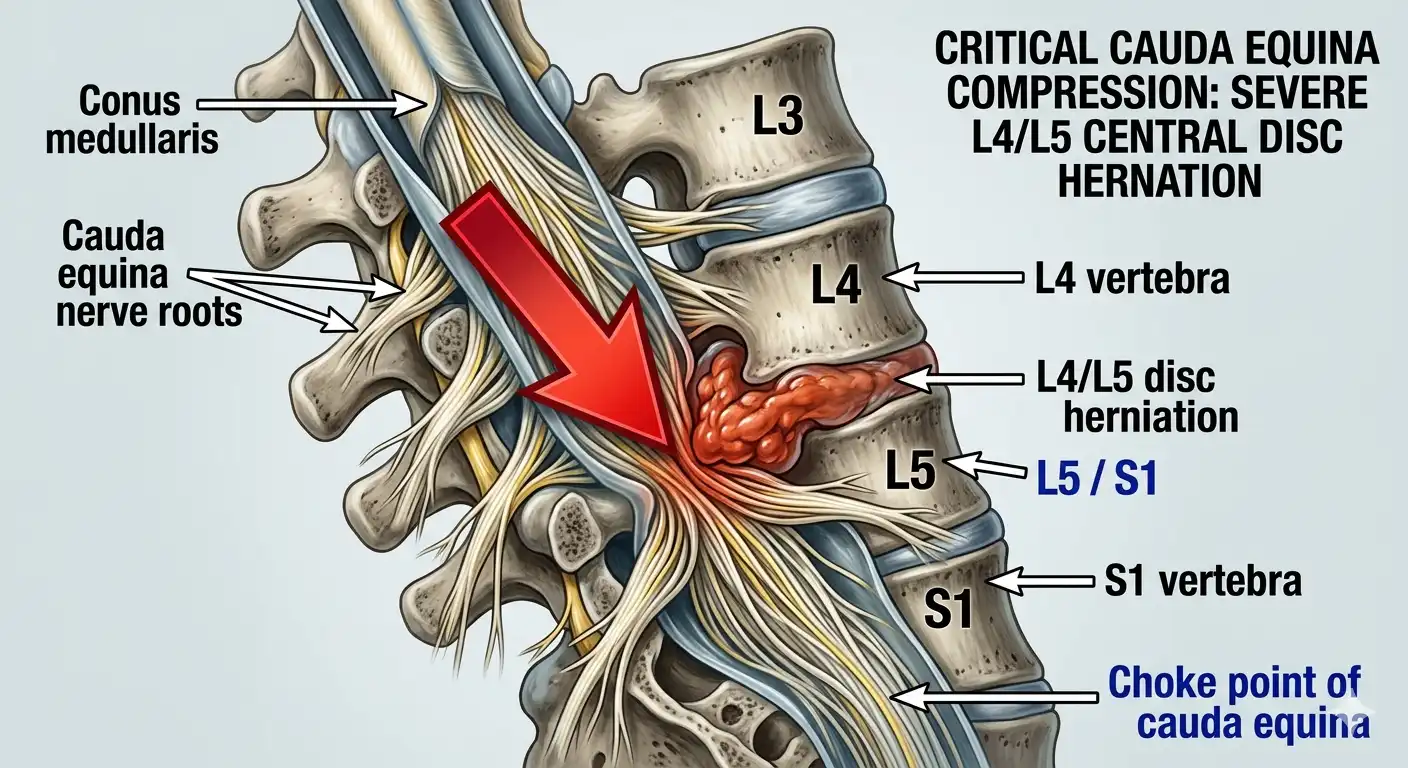
At the base of your moving spine, the solid spinal cord ends. It branches out into a thick, vertical bundle of individual nerve roots that travel down through your pelvis to supply your legs, bladder, and bowel.
Because this vertical bundle looks remarkably like a horse’s tail, early anatomists named it the cauda equina. This dense collection of nerve tissue is responsible for carrying all the electrical signals that control your lower body’s function and internal track control.
If a massive piece of disc material breaks completely free and pushes straight backward into the center of this tunnel, it can compress the entire bundle simultaneously.
This severe mechanical blockage is the cause of a condition known as cauda equina syndrome. Unlike a simple pinched nerve that causes pain down one leg, this central compression starves the primary control lines of their essential blood supply, risking permanent neurological changes if the pressure is not cleared quickly.
Identifying the emergency indicators
A spinal emergency rarely presents as a simple increase in your regular back ache. It is characterized by a sudden, profound drop in your nervous system’s ability to communicate with your lower body.
The first classic indicator is known as saddle anesthesia. If you notice a sudden, profound numbness in the specific parts of your body that would touch the seat of a saddle—including your groin, buttocks, inner thighs, and private areas—your central nerves are under severe structural strain.
The second critical indicator is a progressive, uncontrollable change in your normal internal control functions. This can present as a sudden loss of bladder or bowel control or an inability to pass urine despite feeling that your bladder is completely full.
Pay immediate attention if you experience a sudden, severe weakness in both of your feet, causing you to trip or find it impossible to stand up on your tiptoes.
Treat a rapid, bilateral loss of sensation down both of your legs as a directive to seek an immediate clinical evaluation.
Understand that these neurological signals require emergency decompressive treatment rather than routine outpatient monitoring.
Do not wait through the night to see if the numbness clears on its own; early structural decompression within twenty-four to forty-eight hours provides the highest probability of full nerve recovery.
Acting with calm precision
Discovering these severe symptoms can feel incredibly frightening, but it is important to remain calm and act with purposeful precision.
If you or a family member encounter these specific structural warnings, skip the local physical therapy clinic and travel straight to an advanced medical facility equipped with an on-call spine specialty team.
For standard, non-emergency conditions that cause lingering, severe discomfort across your daily routines, you can safely take the time to evaluate and consult the best doctor for lower back pain relief to design a structured growth plan.
But when the central control lines are actively compressed, fast action is the ultimate form of protection. Know the signs, respect your nervous system’s warnings, and ensure your spine receives the rapid care it needs to keep you moving independently.