
The waking moment of relief
You open your eyes in the quiet recovery room of the clinic. The first thing you notice is not the mild soreness around the small dressing on your lower back. It is something far more profound: the complete absence of the electric, burning pain that has been shooting down your leg for months.
The mechanical pressure on your nerve has been cleared. The constant structural alarm has finally been turned off.
It is completely natural to feel an immediate surge of relief and a desire to return straight to your regular lifestyle. However, this early post-operative period is a critical phase where patience is your most valuable asset.
The nerve root is free, but it remains swollen and sensitive from its long period of confinement. Let us outline a realistic, week-by-week guide so you can navigate your recovery with absolute certainty.
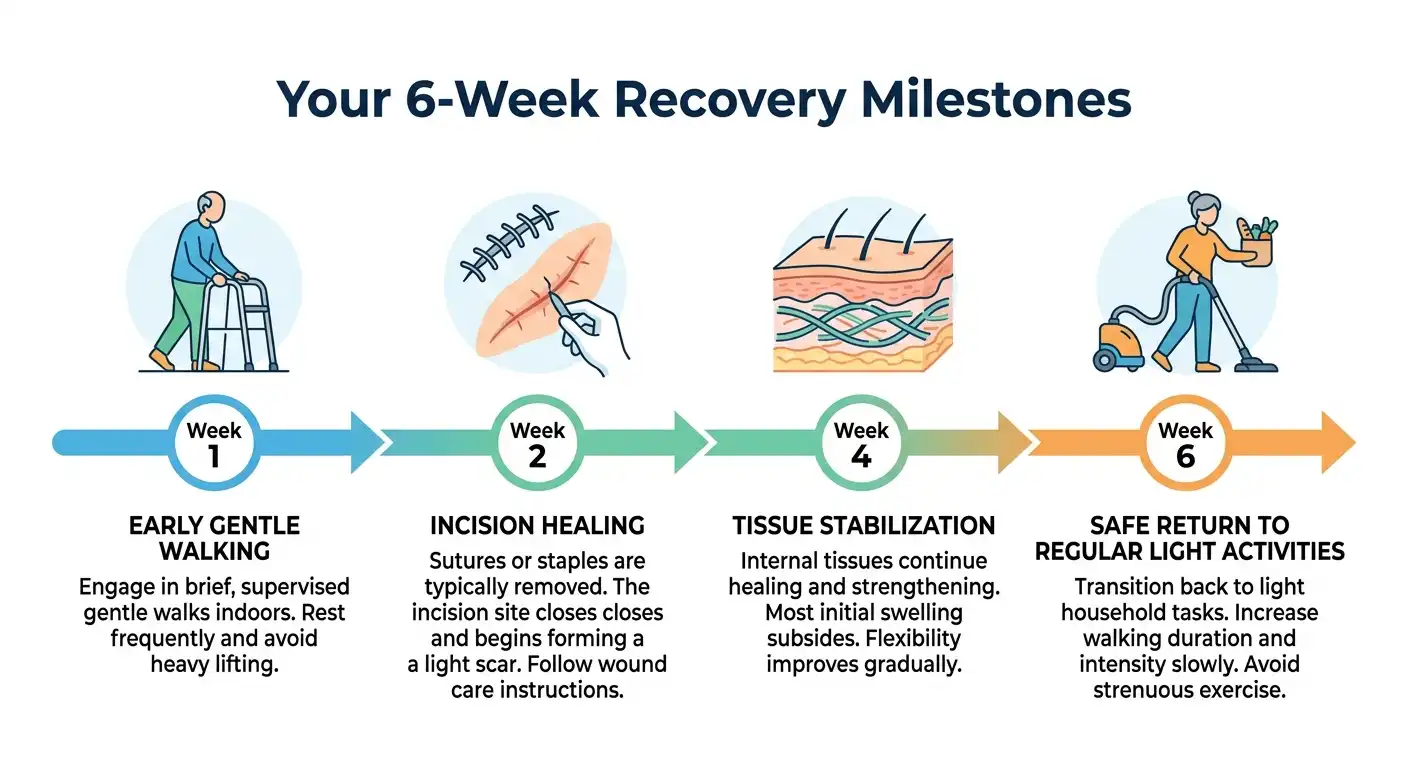
Week 1 to 2: The phase of gentle protection
During the first fourteen days following your procedure, your singular goal is to allow the local tissues to close and heal without unnecessary disturbance.
Your back muscles may feel tight or similar to the deep bruising sensation of a intense workout. You might even experience occasional, brief twinges of your old leg pain. Do not let these variations cause you anxiety; this is simply the nerve root waking up and shedding its residual inflammation.
The most vital physical boundary during this phase is a strict avoidance of the “BLTs”: Bending, Lifting, and Twisting. Your surgical corridor is stable, but the outer wall of the treated disc requires time to scar over and secure itself.
Limit your sitting time to twenty or thirty minutes at a single stretch, as prolonged sitting places a higher vertical load on your healing lower lumbar discs.
Walk on smooth, flat surfaces inside your home for five to ten minutes several times a day to keep your joints lubricated and maintain normal circulation.
When getting out of bed, practice the “log-roll” technique: turn your entire body onto your side as a single unit before using your arms to push your torso upright.
Avoid lifting anything heavier than a small jug of water to keep your lower back muscles completely relaxed.
Week 3 to 6: Rebuilding your daily independence
By the arrival of the third week, the deep surgical soreness will have largely dissolved. Your skin incision is now fully closed, and you can begin to expand your physical boundaries in a controlled, deliberate manner.
This is the window where you can safely increase your walking distance to twenty or thirty minutes a day. Walking is the ultimate low-impact exercise for your recovery; it strengthens your supporting core infrastructure without placing any jarring, mechanical stress on your spine.
If your professional role involves a standard office setup, many patients can explore a gradual, part-time return to desk work around the fourth to sixth week.
If you are currently evaluating your care paths, discussing modern endoscopic and microdiscectomy options with your specialist can give you a clear understanding of how tissue-sparing techniques help compress this overall recovery window.
Beyond Week 6: Securing your long-term health
Once you cross the six-week milestone, your structural framework is highly secure. Under the guidance of a dedicated clinical therapist, you can begin targeted core stabilization routines to build a protective muscular shield around your lower spine.
Returning to a life of full, independent movement is a gradual process of physical adaptation. Do not rush to test your limits by lifting heavy suitcases or returning to high-impact sports right away.
View your procedure not just as a quick fix for a structural block, but as a fresh start for your overall spinal health. By maintaining regular movement habits, keeping your core engaged, and moving with structural awareness, you can protect your investment in your health and live a vibrant, pain-free life for years to come.