The pain that misleads you
You feel a sharp, electric shock travel down the back of your thigh. It passes your knee and moves straight into your calf or foot.
Sitting in an office chair becomes unbearable within ten minutes. Driving a car in heavy traffic turns into physical torture.
The strangest part of this condition is your lower back often feels completely fine. Because the agony stays entirely in your leg, you might think you have pulled a leg muscle.
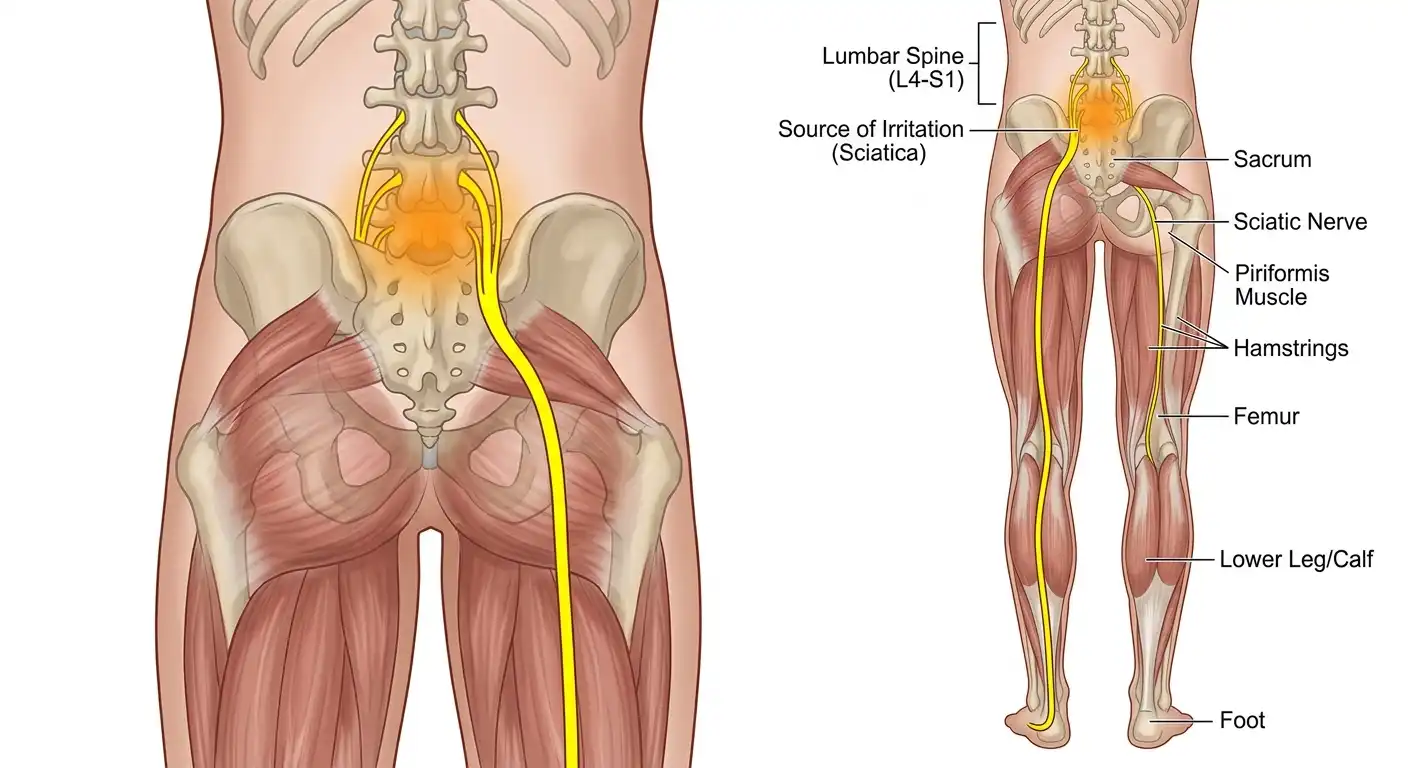
This painful experience is a classic symptom of sciatica. The true problem is not in your leg at all. Your leg is simply reporting an injury that is happening at the base of your spine.
An electrical cable under pressure
Your body has a complex network of nerves that carry signals from your brain to your toes. The sciatic nerve is the largest single nerve in this network. It is as thick as your thumb.
This nerve starts in your lower back, where individual nerve roots branch out from your spinal cord. These roots join together to form a heavy electrical cable that travels through your hip and down your leg.
When your spine is healthy, this cable has plenty of room to move. However, things change if a nearby cushion gets damaged.
If you have a compressed pathway caused by an L4-L5 or L5-S1 disc bulge, the soft disc material presses directly against the nerve root.
This mechanical pressure acts exactly like a heavy boot stepping on a live electrical wire. The nerve sends frantic pain signals down its entire length, causing the intense burning you feel in your calf or foot.
The good news about nerve pressure
Living with severe leg pain is exhausting. It is easy to assume that a compressed nerve requires an immediate operation to cut away the pressure.
The clinical facts tell a very different story. Your body has a powerful ability to clear this mechanical block on its own.
When inner disc material leaks out and touches a nerve, your immune system treats it as a foreign object. It sends specialized cells to break down and absorb the tissue.
Over a few weeks, the protruding material naturally shrinks. As the tissue dries up, the direct pressure on your nerve decreases, and your leg pain begins to fade. This is why sciatica pain treatment without surgery is highly successful for the vast majority of patients.
Practical steps for non-surgical recovery
Overcoming sciatica requires a structured plan that protects your nerve from further irritation while your body works to heal the disc.
First, stop stretching your hamstrings. Many people try to relieve leg tightness by bending forward to touch their toes. If your pain is caused by a pinched nerve in the lower back, bending forward pulls the nerve tight against the disc, making the inflammation worse.
Second, avoid soft, low couches. Sitting on a soft surface forces your lower spine to round backward, which pushes the disc material further out against the nerve root. Choose a firm, straight-backed chair that supports your lower back.
Third, use gravity to unload your spine. Lie flat on your back on a firm mat with your knees bent at a ninety-degree angle, resting your calves on a chair or a stack of firm pillows. This position relaxes the deep muscles around your lower back and relieves the immediate mechanical pull on your sciatic nerve.
Rest on a firm surface for short periods when leg pain spikes, but avoid total bed rest.
Walk on flat ground for ten minutes twice a day to maintain local blood circulation.
Apply a cold gel pack to your lower back for fifteen minutes to calm acute nerve inflammation.
Avoid lifting grocery bags or bending down to pick up objects from the floor.
Understanding advanced conservative options
If simple posture changes and relative rest do not lower your pain levels after a few weeks, you have other non-surgical options.
Your doctor may suggest targeted epidural steroid injections. This procedure delivers powerful anti-inflammatory medicine directly to the exact spot where the nerve is pinched. It does not alter the shape of your disc, but it can rapidly eliminate the local swelling, giving your body a quiet window to complete the natural healing process.
Listen closely to your body during this recovery phase. If you notice your leg pain gradually moving upward toward your back, your nerve is recovering.
With patience, proper movement habits, and the right medical guidance, you can overcome sciatica and return to your active lifestyle safely.