Deciphering the medical code
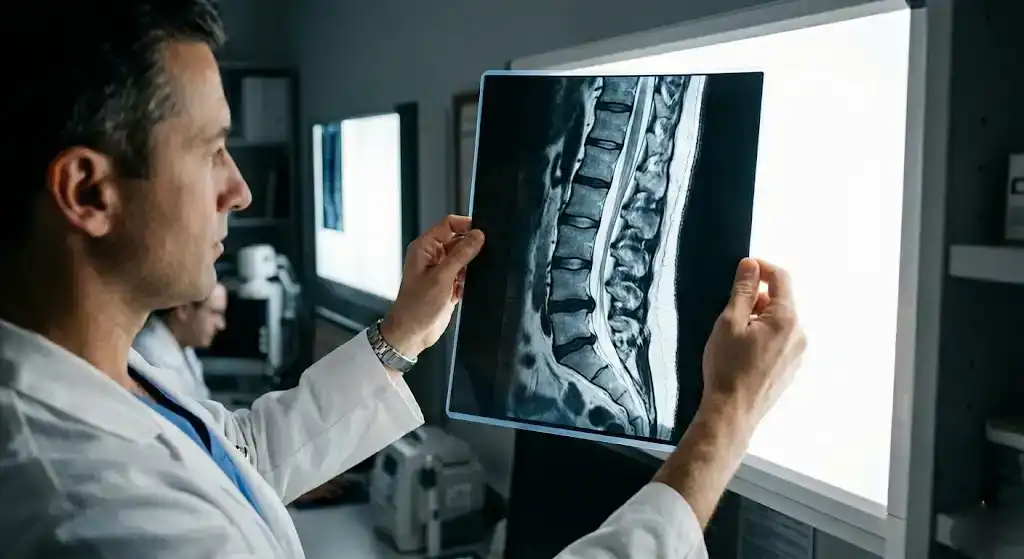
You open the envelope and pull out the printed text of your spine MRI report. Your eyes scan rows of complex terminology.
Words like protrusion, extrusion, indentation, and facet hypertrophy appear on the page. It reads like a description of a structural collapse.
It is completely natural to feel overwhelmed when reading these technical terms. The language used in radiology is highly descriptive, but it often sounds much worse than your actual physical condition.
You do not need a medical degree to understand what is happening inside your spine. Let us translate the medical code into plain English so you can understand your options clearly.
The heavy lifters of your spine
Your spine is built from individual bones called vertebrae, numbered from top to bottom. The lower back region is called the lumbar spine, labeled with the letter L.
The numbers L4 and L5 refer to the two lowest moving bones in your back. The letter S stands for the sacrum, which is the solid triangular bone at the base of your spine.
The spaces between these bones are filled with rubbery cushions. The L4-L5 disc sits between the fourth and fifth lumbar bones. The L5-S1 disc sits at the very bottom, where your moving spine connects to your pelvis.
These two specific discs are the primary heavy lifters of your body. Every time you lift an object, sit at a desk, or twist your body, these cushions absorb the mechanical force. Because they handle the highest structural load, they are the most common sites for wear and tear.
What do bulge and protrusion really mean?
Your spinal discs consist of a tough outer wall made of strong cartilage fibers and a soft, jelly-like core.
A disc bulge means the outer wall has grown slightly weak and stretched outward, much like an underinflated car tire bulging under a heavy load. The outer wall remains intact, but it takes up slightly more space inside the spinal canal.
A lumbar disc protrusion means the tough outer wall has a small tear, allowing a small amount of the inner jelly to push outward into a distinct pocket.
This localized change is what people commonly refer to when discussing a slipped disc treatment. The disc has not slipped out of your back. It has simply changed its shape, which can sometimes bring the soft tissue into contact with a nearby nerve.
Treating the patient, not the scan
The most critical fact to understand about your report is that your symptoms matter far more than the printed text.
Medical studies show that if you take an MRI of one hundred healthy adults with absolutely no back pain, more than half will show an L4-L5 or L5-S1 disc bulge on their scans.
An MRI shows structural variations, but it cannot measure your pain or your ability to move. Your plan for l4 l5 l5 s1 disc bulging treatment must be based on how you feel every day, not just on what the scan looks like.
If your bulging disc is not causing leg numbness or severe pain, you do not need aggressive or invasive treatments. Your spine is highly stable, and your body can manage these changes through regular movement and proper care.
Remember that a descriptive MRI report is a map of your anatomy, not a prediction of your future mobility.
Focus your recovery goals on restoring your physical function and muscle strength.
Understand that disc tissue undergoes natural changes and can adapt over a typical lumbar disc herniation recovery time.
Knowing when to act quickly
While most disc changes can be managed calmly over time, there are a few rare warning signs that require immediate medical attention.
If your lower back pain is accompanied by a sudden numbness in your groin area, or if you experience a progressive loss of bladder or bowel control, you must seek emergency clinical care. These specific symptoms indicate severe central pressure that requires rapid treatment to protect your nerves.
For the vast majority of people, a spine report is simply an invitation to take better care of their back. Partner with a specialist who treats your actual daily limitations rather than just reading a radiology report. With targeted core exercises, proper sitting habits, and a calm mindset, your lower back can remain strong and reliable.
Disclaimer: This content is for informational purposes only and does not substitute for professional medical advice, diagnosis, or treatment.