Demystifying an industrial term
The phrase “spinal fusion” sounds incredibly mechanical and intimidating to the average patient.
When a doctor suggests a fusion to treat severe, chronic back pain, it is easy to imagine your lower spine being turned into a rigid, unbending metal rod. You might worry that you will never be able to bend down to tie your shoes or twist your torso comfortably again.
This common anxiety comes from a misunderstanding of how the spine actually moves. Your lower back is designed to share mechanical loads across multiple moving segments.
When one of those segments becomes severely worn out, loose, or unstable, it creates a constant, painful friction every time you move. A spinal fusion operation is not designed to lock up a healthy back; it is used to stop an unstable, damaged joint from causing continuous pain.
Why is stabilization sometimes essential?
To understand why a fusion is necessary, think of a loose hinge on a heavy door. Every time the door swings, the loose hinge wobbles, damaging the surrounding frame and causing a loud screech.
Inside your lower back, if a disc completely collapses or a bone slides forward due to wear, the nearby joints lose their natural alignment. They begin to move excessively, pinching the passing nerve roots and triggering deep, structural muscle spasms across your waistline.
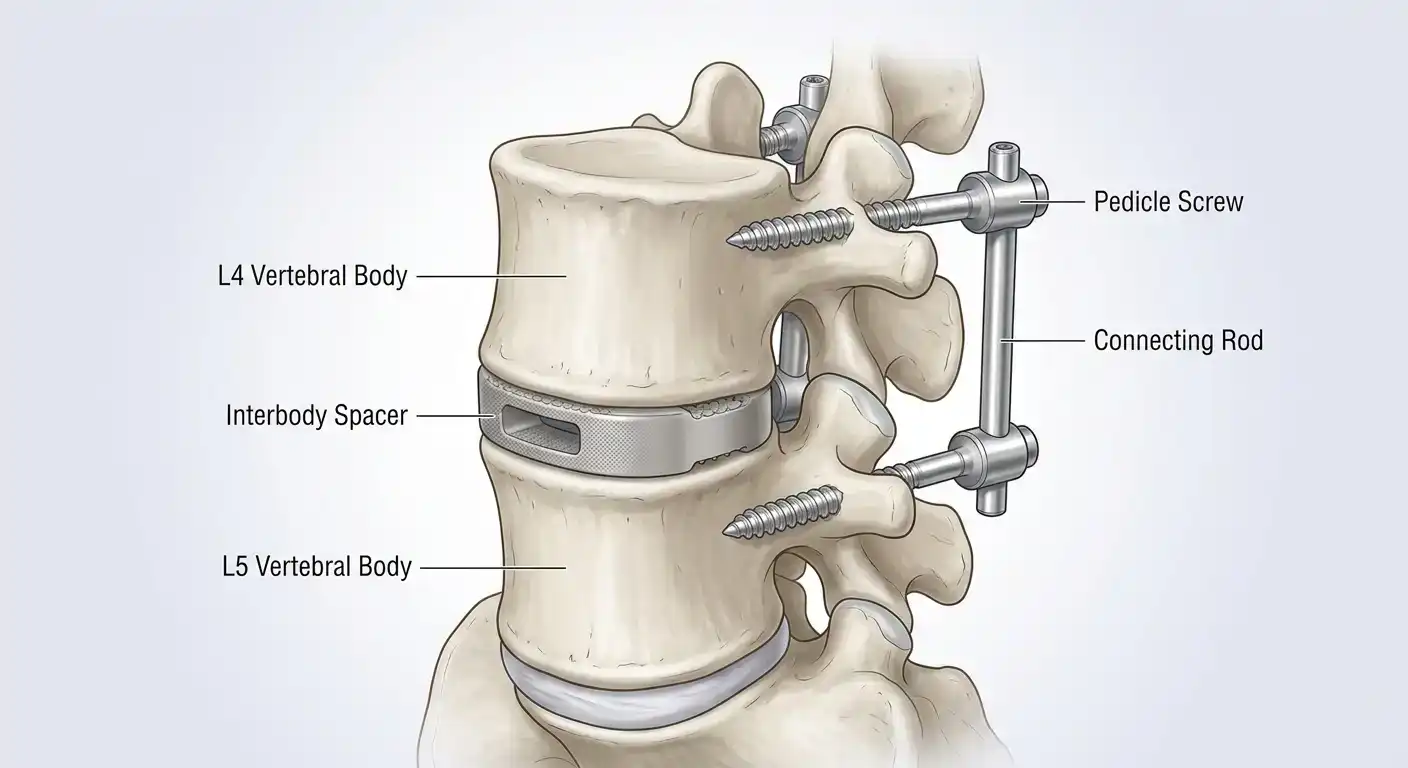
During a stabilization procedure, a specialist carefully clears away the damaged disc material and places a solid structural spacer between the two loose bones.
Then, precision titanium screws and small connecting rods known as lumbar instrumentation are secured to the vertebrae. This hardware acts like a temporary internal splint, holding the two bones perfectly still so they can naturally grow together into a single, solid block of bone over the coming months.
Navigating your recovery with confidence
The day after a stabilization procedure can feel challenging as your body begins to adapt to its newly secured framework.
A modern lumbar spine fusion surgery recovery path does not involve lying motionless in a hospital bed for weeks. In fact, early, controlled movement is the key to an optimal long-term result.
Under the guidance of a clinical physical therapist, you will learn how to log-roll out of bed without twisting your spine and how to use your leg muscles to stand up safely. Walking short distances down a corridor on day one or day two helps stimulate local blood circulation and triggers the bone-healing process.
As the weeks pass, your body deposits new bone cells around the spacer. During this critical healing phase, avoiding heavy lifting or sudden bending is essential to allow the fusion to become completely solid and secure.
Restoring your active lifestyle
A common concern among patients is how much flexibility they will lose after a localized fusion.
Most people are surprised to find that their overall mobility actually improves after the procedure. Because the constant, agonizing joint friction has been eliminated, they can stand straighter and walk much further than they could before the operation.
The surrounding healthy joints in your hips and upper back naturally adapt to handle your daily movements comfortably. If you are feeling anxious about the mechanics of this procedure, taking the time to evaluate the standard spine surgery safety parameters can give you a clear, data-driven perspective on modern technical safeguards.
A spinal fusion is a significant milestone on your health journey, but when performed for the right structural indications, it is a highly reliable way to rebuild a failing foundation. Partner with a specialist who prioritizes your structural safety, and take your first steps toward a stable, active life with confidence.
Disclaimer: This content is for informational purposes only and does not substitute for professional medical advice, diagnosis, or treatment.