When pain travels down your arm
You wake up with a sharp, burning pain that starts in your neck and flashes down your shoulder blade, straight into your arm. It feels like an electric shock.
You might notice a strange tingling in your fingertips or find that your hand feels weak when you try to turn a doorknob.
Pain that stays in one spot is frustrating, but pain that travels down your arm is alarming. It can make you feel completely helpless.
These severe sensations are the classic slipped disc neck symptoms. Let us look at why a problem in your neck is causing pain all the way down in your fingers.
A look at a herniated disc
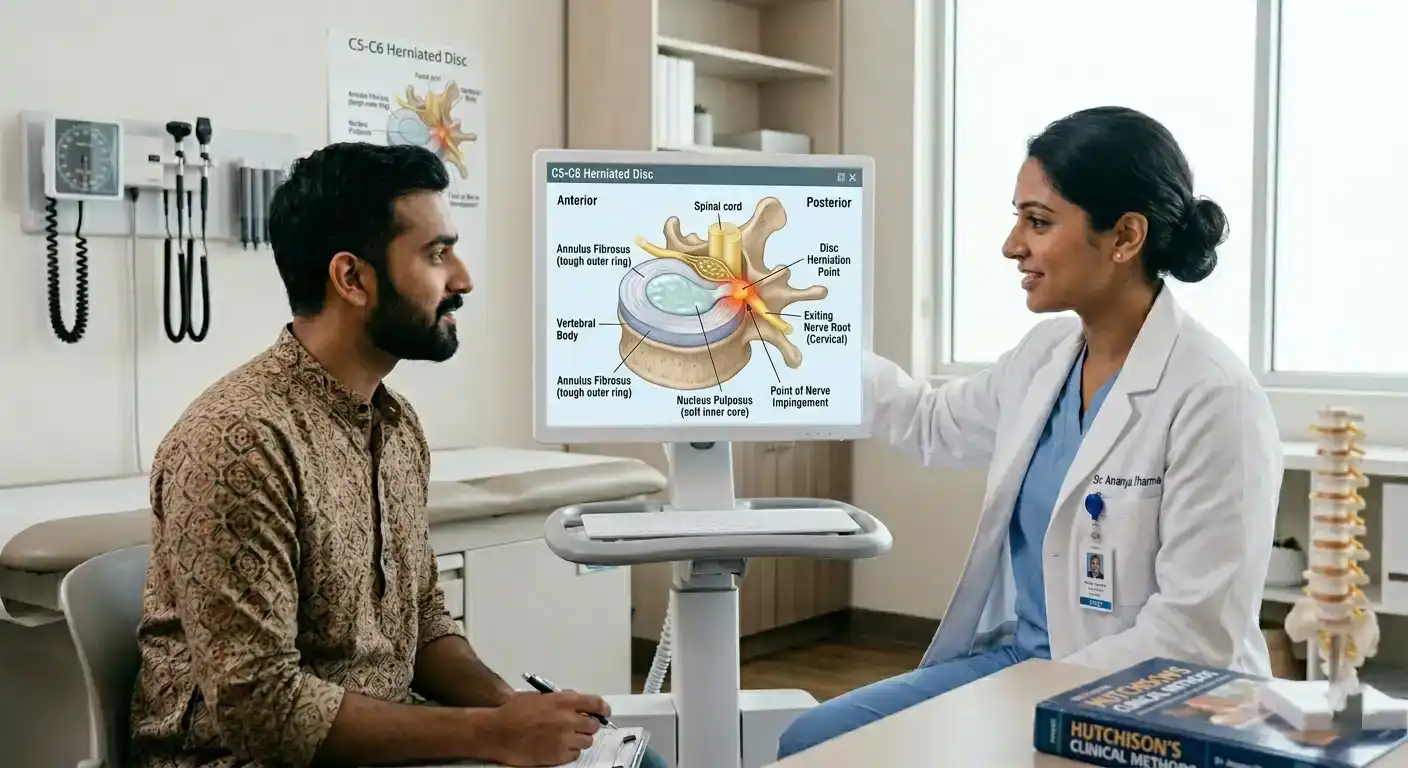
Your cervical spine consists of individual bones separated by circular cushions called discs. These discs have a tough, fibrous outer ring and a soft, jelly-like center. They function exactly like shock absorbers.
When a disc is injured by sudden strain or long-term wear, the outer ring can develop a small tear. A tiny amount of the soft inner jelly pushes outward through this gap.
This structural change is a cervical disc herniation. The disc does not actually slip out from between the bones. Instead, the protruding inner jelly presses against the delicate nerve roots that run from your spinal cord down into your arm.
This pressure is like stepping on a garden hose. The pinch disrupts the electrical signals traveling down the nerve, causing a burning sensation, numbness, or muscle weakness along its path. This specific nerve irritation is what doctors address during cervical radiculopathy treatment.
Your body’s natural healing mechanism
The most important fact about a herniated disc is that your body possesses a remarkable capacity to heal itself. The diagnosis does not automatically mean you need surgery.
In fact, the majority of herniated discs shrink and resolve completely on their own over several weeks.
When disc material pushes outside its normal boundary, your body recognizes it as foreign tissue. It initiates a natural inflammatory response to break down and resorb the protruding jelly.
A successful cervical disc herniation non surgical treatment plan is designed to control your pain and support your body while this natural cleanup process takes place. You do not need to rush into aggressive treatments if your nerves are safe.
Step-by-step conservative management
Finding a successful slip disc treatment without surgery requires patience and a structured approach.
During the first few days of severe pain, the priority is reducing acute inflammation. Your doctor may prescribe short-term anti-inflammatory medications and recommend relative rest. Avoid positions that force your neck to tilt backward or to the side of the pain.
As the sharp pain begins to ease, gentle physical therapy becomes crucial. Specific, targeted movements can help open the small spaces between your neck bones, taking the direct mechanical pressure off the irritated nerve root.
Keep your head in a balanced, neutral position and avoid looking down at tablet screens.
Note exactly which fingers feel numb, as this tells your doctor precisely which disc is pressing on the nerve.
Avoid jerky movements, heavy lifting, or aggressive neck stretching during the healing phase.
Apply an ice pack wrapped in a cloth to the base of your neck for fifteen minutes to calm nerve pain.
Partnering for a safe recovery
Recovering from a disc injury requires careful tracking of your symptoms. If your pain gradually moves out of your arm and back up into your neck, it is a positive sign that the nerve pressure is decreasing.
However, if you notice that your hand weakness is getting worse, or if you struggle to lift your wrist, you need an immediate medical re-evaluation.
Work closely with an experienced spine specialist to monitor your progress. Catching symptoms early ensures you can navigate your recovery safely without unnecessary interventions.