When your hands stop listening to you
You notice a persistent tingling in your hands and fingers while typing or driving. At first, you might assume you simply slept at an awkward angle.
Then, you notice other small changes. You accidentally drop your car keys, or you find it unexpectedly difficult to manage small shirt buttons.
It is deeply unsettling when your hands do not cooperate with your brain. You might wonder if this is a simple circulation issue or a problem coming from your spine.
Your neck is the main gateway for all the nerves traveling to your upper and lower body. Understanding the specific patterns of your symptoms is essential for getting the right care. Let us look at the two distinct ways your neck nerves signal trouble.
Pinched nerve roots vs. spinal cord pressure
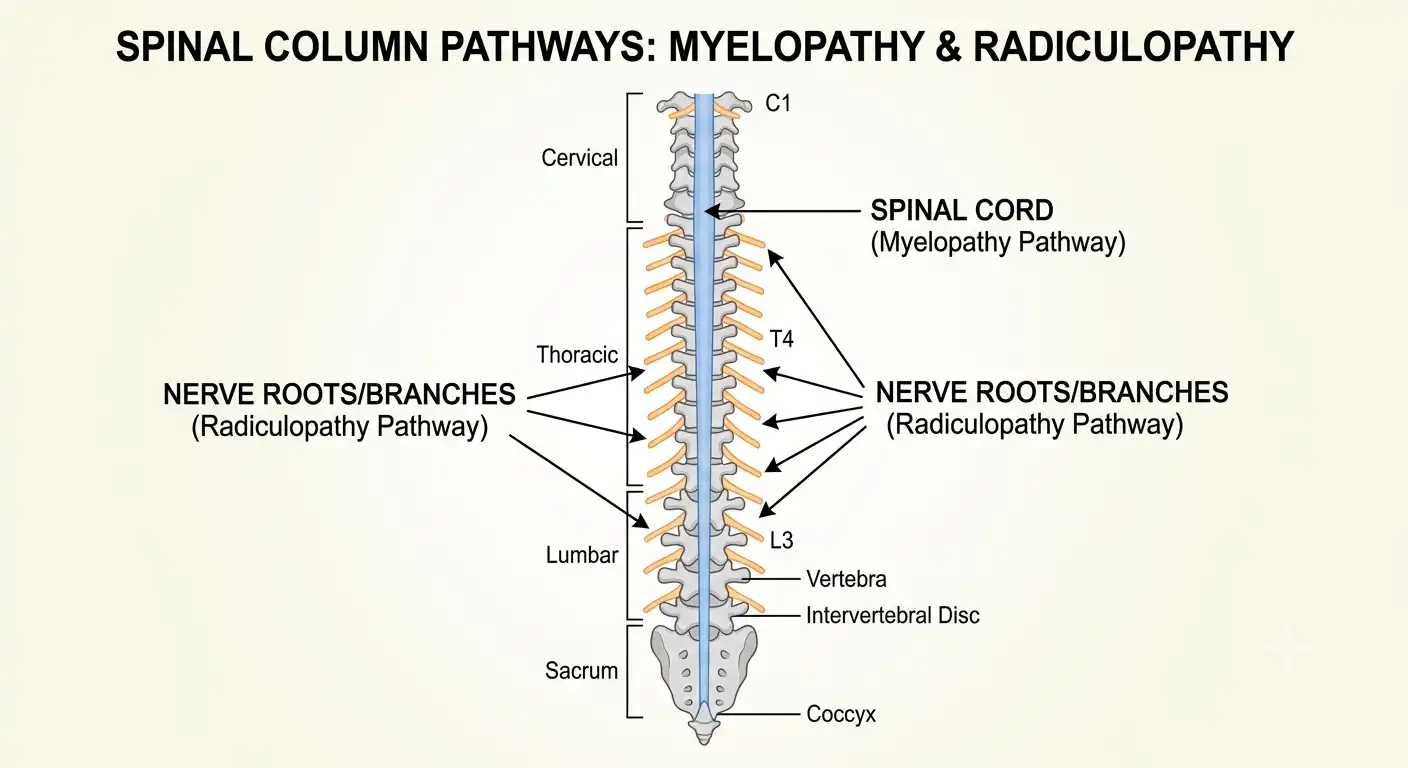
To understand your symptoms, think of your neck’s nerve network like a large highway system. Your spinal cord is the main multi-lane highway running down the center, and the nerve roots are the single-lane exit ramps that branch off to your arms.
When a single exit ramp is squeezed by a disc herniation or a bone spur, you experience cervical radiculopathy symptoms.
This condition typically causes pain, numbness, or tingling that travels down one specific arm into certain fingers. It is uncomfortable, but it is limited to that single nerve path.
The situation changes entirely if the main highway itself experiences pressure. Structural compression of the central spinal cord triggers cervical myelopathy signs.
Because the spinal cord carries signals to your entire body, myelopathy does not usually cause sharp arm pain. Instead, it alters your overall coordination.
You might notice balance problems, neck pain, or a feeling that your feet are heavy and clumsy when you walk across a room.
How to read your body’s warning signs?
Recognizing these differences helps you describe your condition accurately to your doctor, ensuring you receive the correct diagnostic scans.
Radiculopathy symptoms usually fluctuate depending on how you move your head. Certain angles can pinch the nerve root tighter, while other positions offer relief.
Myelopathy signs tend to be constant and affect your fine motor skills. If you notice your handwriting changing significantly, or if you feel unsteady on your feet in the dark, these are clear signs that your spinal cord requires immediate clinical attention.
Tracking your symptoms for your doctor
When you visit a specialist, the specific details of your daily challenges are more valuable than an MRI image alone. Pay close attention to how your body behaves during normal tasks.
Observe if your hand clumsiness affects just one side or both hands simultaneously.
Notice if your walking step has widened to keep you from losing your balance.
Document any sudden, electric sensations that shoot down your back when you bend your head forward.
Taking timely action
Discovering these signs early gives you a significant advantage. While a single pinched nerve root can often be managed with rest and physical therapy, central spinal cord pressure requires careful monitoring by an expert team.
Never ignore progressive numbness or walking changes. Your nervous system is highly resilient, but it relies on timely professional evaluation to protect your long-term mobility and independence.