
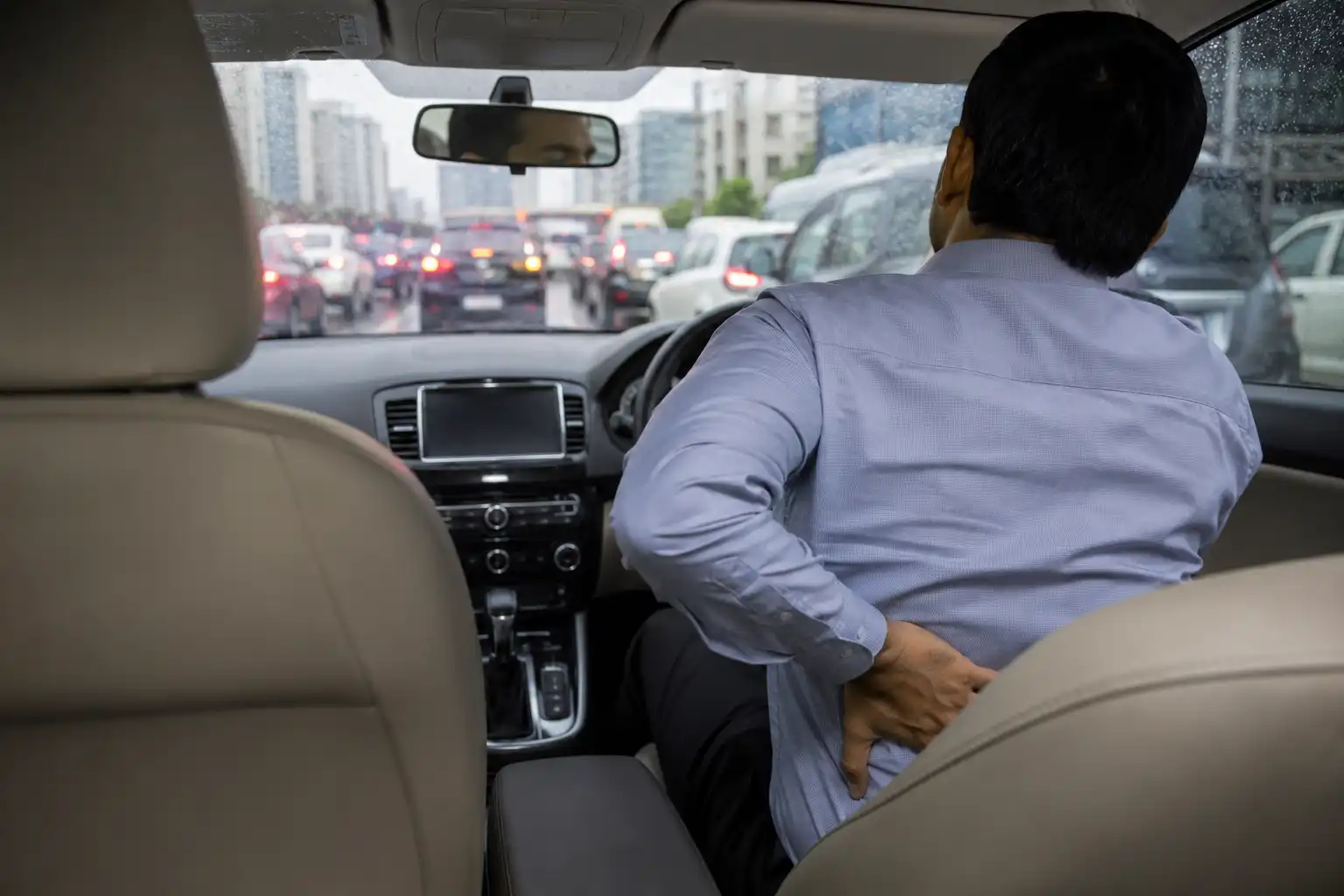
The high cost of the daily travel grind
You step into your vehicle or board a crowded train to start your morning journey. Within forty-five minutes of sitting in bumper-to-bumper traffic or standing on an uneven, moving floor, a deep, tight ache begins to radiate across your lower back.
By the time you reach your office desk, your spine feels compressed, rigid, and completely exhausted before your true workday has even started.
You might tell yourself that this is simply the inevitable cost of living in a sprawling metropolitan area like Mumbai or Thane. You look at the crowded roads and assume that millions of others are quietly enduring the exact same daily physical tax.
Enduring chronic pain is not a badge of honor, nor is it a sustainable way to live. Your daily travel routine is actively placing an unnatural mechanical load on the base of your spine. Let us pull back the curtain on the physics
The hidden physics of road vibrations
When you sit flat on a standard office chair, your spine handles a significant amount of vertical pressure. However, when you sit in a driver’s seat or an auto-rickshaw, that structural pressure is multiplied by a highly destructive physical force: whole-body vibration.
As your vehicle travels over uneven pavement, speed bumps, and unexpected potholes, low-frequency vibrations pass directly through the vehicle floor and straight into your pelvis.
Your lower back muscles cannot relax during this process. To keep your torso upright on an unstable surface, these deep muscles must continuously perform micro-contractions every single second.
When trying to identify the root lower back pain causes, professionals often overlook how this constant muscular overwork combines with a poor seating posture.
Most car and transit seats are shaped like deep buckets, which forces your pelvis to roll backward. This backward tilt completely flattens the natural forward curve of your lower back, pushing your rubbery discs out against your spinal nerves while your body absorbs the relentless mechanical shocks of the road.
Practical tactics for transit survival
Alleviating travel-induced compression does not require changing your career or abandoning your daily route. It requires introducing simple, non-negotiable structural boundaries to protect your spine during transit.
First, restore your natural spinal shape immediately. Take a firm lumbar support roll or even a tightly rolled bath towel and place it directly behind your waistline, just above your belt. This simple boundary prevents your pelvis from sinking backward into a slump, ensuring your discs distribute your upper-body weight evenly.
Second, adjust your driving distance. Many drivers slide their seats too far back, forcing them to reach forward for the steering wheel and pedal controls. This reaching movement pulls the sciatic nerve tight and increases spinal tension. Slide your seat forward until your knees are slightly bent and sit at an angle that allows your shoulder blades to stay in firm contact with the backrest.
If you travel by local train or bus, avoid standing with all your weight shifted onto one leg; distribute your weight evenly across both feet to balance your pelvis.
Hold onto a secure overhead rail with a slightly bent elbow to let your arm muscles absorb a portion of the vehicle’s sudden movements.
Keep your phone out of your back pocket while traveling, as sitting on a thick wallet or device tilts your pelvis to one side, creating an uneven foundation.
Take deep, controlled belly breaths during long traffic delays to actively reduce structural muscle tension across your lower spine.
Reversing the commute damage at home
When you finally arrive home after a long evening journey, your natural instinct might be to collapse straight onto a soft, plush couch to unwind.
This habit actually continues the damage. A soft couch forces your already exhausted lumbar spine back into the exact same rounded, compressed shape it endured in traffic for hours.
Instead, dedicate just five minutes after your commute to actively unloading your spinal column. Lie flat on your back on a firm floor mat with your calves resting comfortably on a chair or a stack of hard cushions.
This simple position allows gravity to gently open up the compressed spaces between your vertebrae and brings fresh, hydrating fluids back into your tired discs. Managing your lifestyle habits is a cornerstone of achieving lasting commuter back pain relief.
Your daily travel is a routine requirement, but it does not have to dictate the future of your mobility. By building a supportive environment in your vehicle and treating your body with structural respect, you can arrive at your destination feeling strong, capable, and entirely pain-free.TS