
The fear of a permanent break
You drop a piece of paper, bend down to pick it up, and your back suddenly locks. The pain is immediate, sharp, and blinding.
In the days that follow, you find yourself walking with a slight tilt just to stay upright. You look at your X-ray or MRI film and see a disc bulging out of its neat alignment.
It is easy to look at that image and think your spine is permanently broken. You might assume that once a rubbery disc pushes out of place, it stays out of place forever unless a surgeon cuts it away.
This is a common misconception that keeps thousands of patients living in unnecessary anxiety. Your spine is a living, changing structure, not a rigid piece of plastic.
How your body cleans up the mess
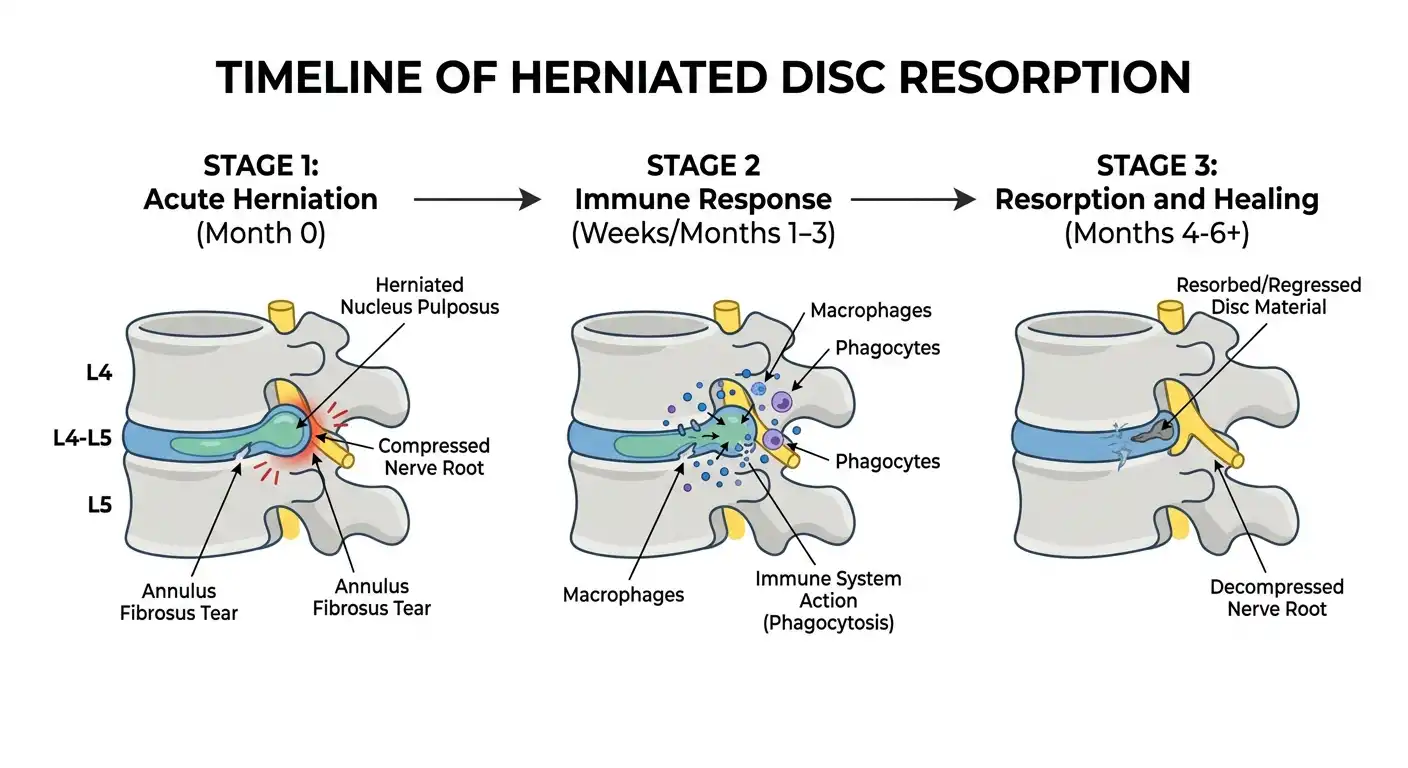
When a disc tears and its soft inner material leaks out, it creates a structural problem. However, your body does not ignore this leak.
The soft jelly inside your disc is meant to stay sealed within its tough cartilage outer wall. When it breaks out and enters the spinal canal, it comes into contact with your blood supply.
Your immune system instantly identifies this leaked jelly as a foreign object, much like a wooden splinter under your skin. It triggers an immediate inflammatory response.
Specialized cells travel to the area to break down, digest, and clear away the loose material. This natural breakdown is known as the disc resorption process.
As the months pass, the protruding disc material loses its water content, dries up, and shrinks. This natural shrinkage is the secret behind successful slipped disc natural healing.
What to expect during your recovery
Knowing that a disc can heal naturally is reassuring, but you want to know how long the process takes. You want a realistic roadmap for your daily life.
The typical lumbar disc herniation recovery time spans between six to twelve weeks for the majority of patients. This is the period required for the acute inflammation to drop and for the disc material to begin shrinking.
During the first two weeks, your pain might fluctuate wildly as your immune system actively processes the tissue. This is when your sciatica recovery timeline begins to stabilize.
If your leg pain starts to recede back up into your lower back, your nerve is successfully escaping the mechanical pinch. This movement of pain is a reliable sign of physical progress.
Supporting your spine’s natural repair
Your body will do the heavy lifting of clearing the disc material, but your daily habits dictate whether the nerve stays irritated during the process.
First, do not spend weeks resting completely in bed. Prolonged bed rest weakens your core muscles and stiffens your spinal joints, which actually delays your long-term recovery. Move gently within your pain-free limits.
Second, walk on smooth, flat surfaces for ten to fifteen minutes several times a day. Walking pumps fresh blood and oxygen into your lower back, supplying your immune cells with the energy they need to clear the damaged tissue.
Avoid deep forward bending or twisting your spine while holding heavy objects.
Sit in a supportive chair that maintains the natural forward curve of your lower back.
Use a cold pack for fifteen minutes at a time to numb sharp, acute nerve pain spikes.
Drink plenty of water to support overall cellular health during the tissue clearance phase.
Knowing when nature needs assistance
While the natural clearance of a disc is highly common, it does not happen for every single patient. Sometimes the fragment is too large, or the local blood supply cannot reach it effectively.
If your leg pain remains completely unchanged after six weeks of careful, conservative management, you need a professional reassessment.
If you develop a progressive weakness in your foot that causes you to trip while walking, you should not wait for natural healing.
In these specific scenarios, discussing modern surgical solutions like a microdiscectomy recovery timeline becomes a practical next step to protect your nerve from lasting injury.
Listen to your body, give it a fair chance to heal, and use expert clinical guidance to keep your recovery moving forward safely.