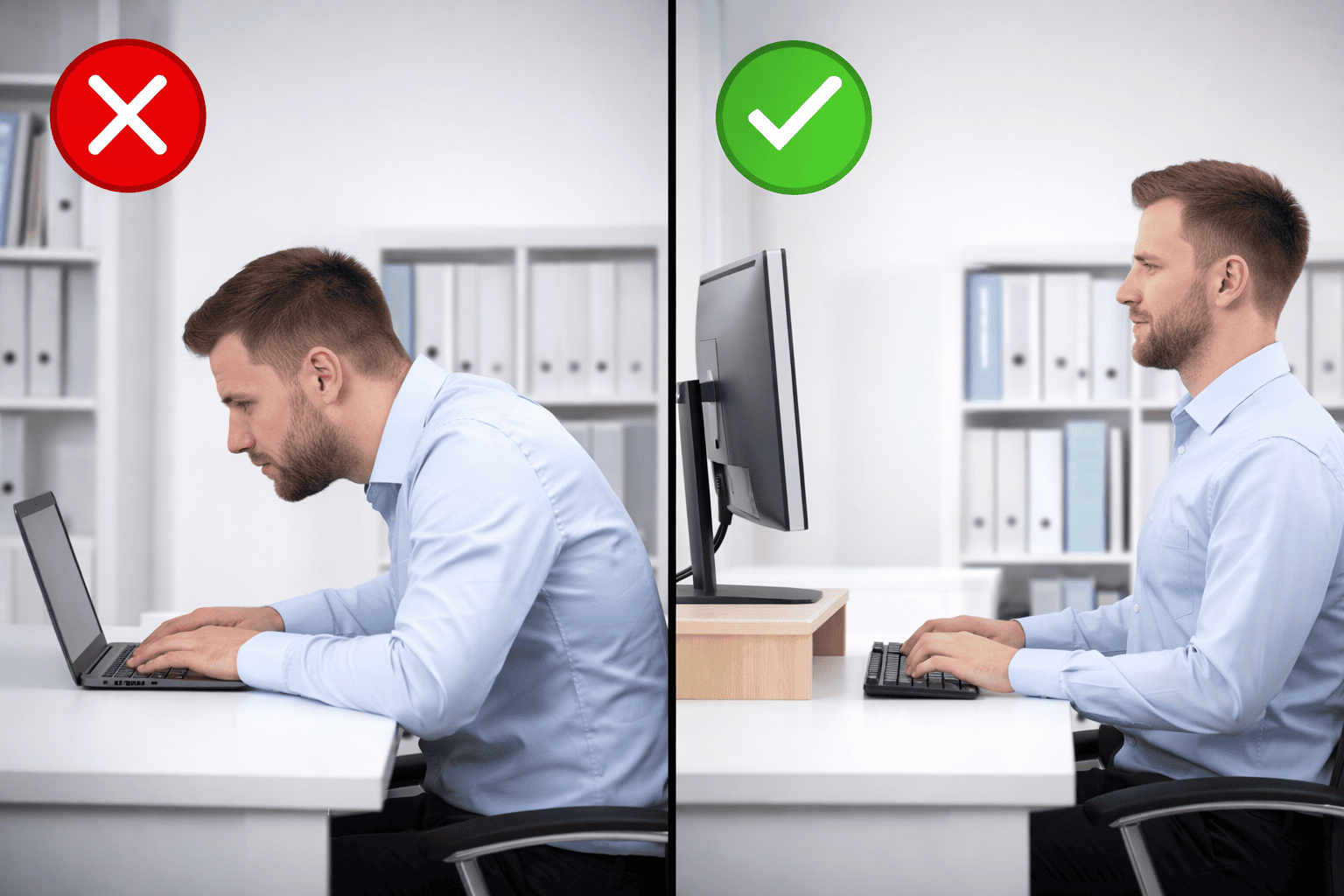
The average human head weighs about 5kg—roughly the size of a large bowling ball. But did you know that when you tilt your head forward just 45 degrees to look at your laptop or phone, your neck feels like it’s supporting 22kg? That is the equivalent of carrying an 8-year-old child on your neck for 8 hours a day. No wonder you’re stiff!
Why “Neutral” Matters
Your cervical spine (neck) is designed to carry weight in a perfectly vertical line. When you slouch:
- Ligament Strain: The ligaments at the back of your neck get overstretched.
- Disc Pressure: The front of your spinal discs get “pinched,” which can eventually lead to a bulging or slipped disc.
- Muscle Fatigue: Your “traps” (shoulder muscles) have to work overtime to keep your head from falling forward, leading to those painful “knots.”
The 3 Pillars of a Pain-Free Desk
- The Eye-Level Rule: Your monitor should be positioned so that the top third of the screen is at eye level. If you use a laptop, buy a stand and an external keyboard.
- The 90-90-90 Rule: Your elbows should be at 90 degrees, your hips at 90 degrees, and your feet flat on the floor.
- The 20-20-20 Rule: Every 20 minutes, look at something 20 feet away for 20 seconds. This relaxes the eye muscles, which are directly linked to the small muscles at the base of your skull.
Actionable Tip: The “Chin Tuck”
While sitting, gently pull your chin straight back (as if making a double chin) without tilting your head up or down. Hold for 5 seconds. This “resets” your vertebrae and strengthens the deep neck flexors.
FAQ’s
1. Can "tech neck" be permanently reversed?
Yes, in most cases. Tech-neck is primarily a repetitive strain issue affecting muscles and ligaments. However, if left unaddressed for years, it can lead to permanent disc degeneration, so early intervention is key.
2. Why does neck stiffness often cause headaches?
This is known as a cervicogenic headache. When you slouch, the muscles at the base of your skull (suboccipitals) become extremely tight. The pain “refers” upward, often feeling like a tight band around your forehead or pressure behind your eyes.
3. What is the best sleeping position for neck pain?
The goal is to maintain a “neutral spine.” Back sleepers, Side sleepers and Avoid Sleeping on your stomach.
4. How long does it take to fix neck stiffness from sitting?
Most people feel a noticeable reduction in tension within 1 to 2 weeks of consistent ergonomic changes.
5. When should I see a doctor for neck pain?
While most desk-related stiffness is muscular, you should consult a professional if you experience: Radiculopathy, weakness and persistent pain.
Book Your Consultation Today
Symptoms often resolve before imaging normalizes. Function, not the picture, is the primary goal.
Our Synapse Spine Clinic is located in Vasai, Bandra, Andheri, Mira Road, Vile Parle, Chembur, Borivali, and Virar.
📞 Contact Numbers with call button for each number:
+91 81698 45056 | +91 93726 71858 | +91 93211 24611 | +91 74998 98303